
Sometimes, the most meaningful discoveries are the ones we never set out to find. Recently, I discovered the remarkable story of a pioneering woman who once owned and lived in our home, and it has given me an entirely new appreciation for the history of this property and the women who helped shape Napa Valley.
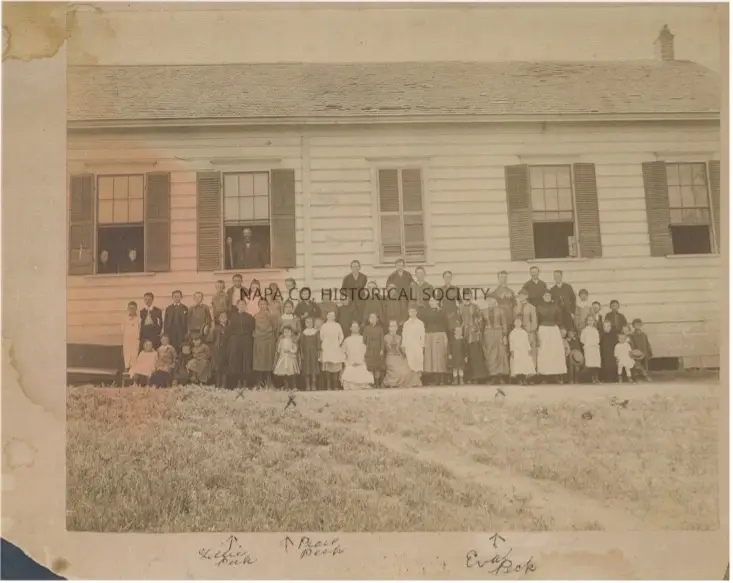
Our home was once one of Napa’s original schoolhouses, known as Harmony School. It is from this history that we took the name for our vineyard, Harmony School Vineyard. What I never imagined was that the property would also have a connection to such an extraordinary woman.
Her name was Estella Patteson.
Born in 1892, Estella transformed the old schoolhouse into her home and established one of the few female-run homesteads in the area. She managed the property on her own, at a time when Napa Valley was better known for its walnuts and prunes than its vineyards. Her family had come to Napa from Texas in the years following the Civil War, and she spent much of her life cultivating and sustaining this land. Waking up before sunrise to start the wood-burning oven, milk cows, feed livestock. Then tend to vegetables, make repairs, and prepare horses for hauling. At 9am, depending on the season, Estella would likely cultivate the field, prune, plant, or harvest. Noontime she would prepare her lunch and get back to tending the field at 1pm followed by repairs, washing clothes, preserving food, and trips to town for supplies. From 5pm to bedtime, the focus would be to feed animals, prepare dinner, clean equipment, prepare for the next day, and maybe a little socializing with the neighbors. She passed away in 1975 and was laid to rest in the cemetery just down the street from our home.
After learning about Estella, I found myself walking the vineyard, trying to imagine what life must have been like for her. I suspect the challenges she faced were far greater than anything I will ever experience. There were no guarantees, no conveniences, and likely very few people she could rely on because of the demands of farming, the distance between neighbors, and the demands of raising a family. This land was her livelihood, and I can only imagine the determination, resourcefulness, and resilience it must have taken to make a life here and maintain her independence.
As I walked, I noticed a heavily oxidized piece of iron partially hidden in the earth. Curious, I picked it up and eventually discovered it was an antique leaf spring that had served as a latch on horse-drawn equipment. In that moment, I felt an unexpected connection to Estella. I couldn’t help but wonder whether this small piece of history had once been in her hands. It was as if the land had offered me a tangible reminder of the person who had cared for it long before us.
That simple piece of iron became something much more meaningful. It connected me to Estella, to the history of this property, and to the generations of people whose hard work and determination made this place what it is today.
I feel incredibly fortunate to be the current steward of this land. But discovering Estella’s story has also prompted me to reflect on the many remarkable women who have inspired me throughout my life.
I have come to realize that I have often underestimated what it truly takes for women to achieve success. We sometimes see the accomplishments without fully appreciating the intelligence, courage, perseverance, sacrifice, and quiet determination behind them. We may recognize the outcome without understanding the obstacles overcome along the way. So much of what makes these women extraordinary is not always visible. It is found in their resilience, their ability to navigate adversity, their willingness to take risks, and their commitment to building something meaningful, often without recognition or acknowledgment.
I have tremendous admiration and gratitude for these women. Their accomplishments deserve to be celebrated, but so does the strength of character that made those accomplishments possible. They have taught me that success is not simply about what someone achieves, but about the conviction, integrity, and perseverance with which they live their lives.
Estella may never have imagined that, more than a century later, someone would be walking the same land, discovering a small piece of iron, and feeling inspired by her story. Yet here I am, reminded that the impact of a person’s life can extend far beyond their own time.
Today, we are fortunate to care for this property and continue its story through Harmony School Vineyard. Knowing that it was once home to a woman of such independence and determination makes that responsibility even more meaningful.
I hope that, in our own small way, we honor Estella’s legacy and the remarkable women who came before us. We may be the current stewards of this land, but we are also beneficiaries of the strength, vision, and perseverance of those who helped shape it. And for that, I am deeply grateful.