
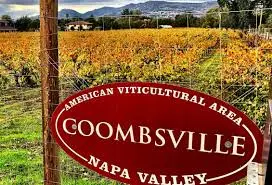
When wine lovers ask “What makes the Coombsville AVA so special?”, the answer begins millions of years ago.
While many visitors come to Napa Valley searching for famous expressions of Cabernet Sauvignon, many discover that some of the region’s most distinctive wines come from much smaller family-owned vineyards. At Farang Wine, we believe understanding the land is the first step toward appreciating what’s in the glass.
Coombsville AVA: Napa Valley’s Ancient Volcanic Landscape
One of the defining characteristics of the Coombsville American Viticultural Area (AVA) is that it sits within the remnants of an ancient volcanic caldera. After the volcano collapsed upon itself, thousands of years of volcanic activity, erosion, and sediment deposits created soils unlike anywhere else in Napa Valley.
These volcanic soils along with long a cooler maturing climate influenced by the proximity to San Francisco Bay are among the reasons Coombsville has become known among sommeliers and winemakers for producing wines with remarkable freshness, elegance, and mineral complexity.
In The Winemaker’s Dance, authors Jonathan Swinchatt and David G. Howell explain that Alta Heights and the surrounding hills are the toe deposits of an ancient range that gradually slipped toward the Napa River, creating the complex geological structure that defines today’s Coombsville landscape.
A Unique Corner of Coombsville
Our vineyard sits just west of the intersection of Coombsville Road and 4th Avenue in Napa, an area that has fascinated me as I’ve learned more about its’ geological history.
According to the landmark 1938 Napa County Soil Survey, this area is classified as Coombsville Gravelly Loam—a well-drained, moderately permeable soil rich in volcanic ash, gravel, and fractured rock.
For grapevines, these soils are nearly ideal.
Excellent drainage encourages vines to develop deep root systems in search of water and nutrients. Moderate water-holding capacity naturally limits vine vigor while allowing grapes to ripen slowly and evenly. The result is fruit that consistently expresses freshness, structure, minerality, and balance rather than excessive ripeness.
These are qualities that have helped establish Coombsville as one of Napa Valley’s most respected Cabernet Sauvignon regions.
Why This Hillside Is Different
Our small hillside occupies the high point between Spencer Creek to the south and Murphy Creek to the north, both of which eventually feed into Tulucay Creek.
Over thousands of years, these waterways transported and deposited minerals that originated in the eastern Wild Horse Valley mountains. This geological process created subtle but meaningful differences across even short distances.
Much like the great vineyards of Burgundy, Coombsville demonstrates that terroir can change dramatically from one hillside—or even one acre—to the next.
These differences are precisely what make vineyard-designated wines so compelling.
Two Vineyards, Two Expressions of the Same Place
Two neighboring wineries beautifully showcase this unique terroir.
Lunar Ridge Winery produces a Syrah planted across the crest of the hill, where vines benefit from both northern and southern sun exposure producing wine reflecting Coombsville which is recognized by soft, but significant tannins providing excellent structure and mouthfeel.
At Farang Wine, our Harmony School Vineyard Cabernet Sauvignon is grown on the southern slope of the same hillside, where slightly deeper soils and different sun exposure create a distinctive expression of Coombsville Cabernet Sauvignon.
Although the vineyards are neighbors, each produces wines with its own personality while remaining unmistakably rooted in the character of this remarkable site.
Exploring the Soils by Hand
One of the joys of working in a small vineyard is the opportunity to know the land intimately.
Over the years, I’ve spent countless hours digging through the soils on both sides of the hill.
On the northern exposure, the ground contains abundant fractured rock and significant amounts of dolomite—a calcium-rich sedimentary mineral—creating thinner, rockier soils.
The southern exposure tells a different story. Here, layers of clay and loam gradually deepen above volcanic bedrock as the slope descends toward Spencer Creek. These soils retain slightly more moisture while still providing excellent drainage.
These subtle geological differences influence how the vines grow and, ultimately, how the wines taste.
What Does This Mean in Your Glass?
Whether you’re enjoying Lunar Ridge’s Syrah or Farang Wine’s Harmony School Vineyard Cabernet Sauvignon, you’ll experience wines that reflect this distinctive corner of Coombsville.
Expect wines with:
- Elegant structure rather than excessive weight
- Mature silky-smooth tannins
- Bright natural acidity
- Layered minerality
- Balance that allows them to be enjoyable upon release while continuing to evolve beautifully for a decade or more
These characteristics are not accidental—they are the expression of a place shaped by ancient volcanoes, flowing creeks, and generations of careful farming.
Experience Coombsville Through Farang Wine
If you’re searching for a unique Napa Valley experience to can share with those at home consider adding a visit to family owned winery, or if you’re curious about why Coombsville Cabernet Sauvignon has become one of Napa’s most exciting wine regions, we invite you to experience it firsthand.
At Farang Wine, we produce small-lot, vineyard-designated Cabernet Sauvignon that reflects the unique geology and terroir of the Harmony School Vineyard. Every bottle is crafted to tell the story of this extraordinary hillside and region.
Whether you’re planning a Napa Valley wine tasting or simply looking to discover a hidden gem beyond the larger wineries, we’d love to share the story—and the wines—that make this special corner of Coombsville unlike anywhere else.
Visit www.FarangWine.com and www.LunarRidge.com to learn more about our wines, our vineyards, and how the remarkable geology and climate of Coombsville shapes every vintage.